In This Article
- The Ultimate Collector Crossroads
- The Appeal Of The Chronograph Complication
- The Practicality Of The GMT Complication
- Flyer Versus Caller GMT Movements Explained
- Head To Head: Rolex Daytona Versus GMT Master II
- Community Insights: What Do Collectors Actually Use
- Maintenance And Servicing Costs
- The Toronto Watch Exchange Verdict
The Ultimate Collector Crossroads
Every watch collector eventually reaches a highly predictable crossroads. You have already acquired a rock-solid, reliable luxury dive watch for daily wear. Now, you are ready to expand your collection and introduce some serious mechanical complexity. You begin navigating the secondary watch market looking for a showstopper, and the decision almost always boils down to two legendary complications. Do you buy a Chronograph, or do you buy a GMT?
Both complications carry immense historical weight. Both command significant premiums on the secondary market. However, they serve entirely different masters. One is rooted in the high-octane worlds of motorsport and space exploration. The other was purpose-built for the glamorous dawn of the transatlantic jet age. Choosing between them is not just a matter of aesthetics; it is a matter of deciding which mechanical function actually fits your lifestyle in 2026.
In this deep dive, we will strip away the marketing romance. We will break down exactly how these complications function, examine the hidden costs of ownership, and help you decide which tool you will actually use on a daily basis before you browse our curated pre-owned watch shop.
The Appeal Of The Chronograph Complication
A chronograph is, at its core, a highly advanced mechanical stopwatch built into a traditional wristwatch. The aesthetic appeal of a chronograph is undeniable. The presence of additional pushers on the side of the case and the complex array of sub-dials give the watch a heavily instrument-focused, technical appearance.
Historically, chronographs were essential life-saving tools. Race car drivers used them to calculate lap times and average speeds via tachymeter bezels. Astronauts famously relied on the Omega Speedmaster to time critical engine burns during the Apollo 13 crisis. The heritage attached to this complication is massive.
However, the modern reality of owning a chronograph is often quite different. When deciding if this complication is right for you, consider these practical daily realities:
- Tactile Interaction: The primary joy of a chronograph is physical. Pressing a mechanical pusher and watching the sweeping seconds hand engage offers a deeply satisfying, tactile connection to the micro-engineering on your wrist.
- Visual Complexity: Chronographs simply look cool. The busy dial layout provides depth and texture that a standard three-hand watch cannot match.
- The Reality of Use: Most modern collectors rarely use their chronographs for life-or-death calculations. They are frequently used to time grilling steaks, French press coffee, or laundry cycles.
- Legibility Issues: Due to the sheer amount of information packed onto the dial, some chronographs can be difficult to read quickly at a glance, especially in low-light conditions.
If you find yourself constantly measuring short intervals of time, or if you simply love the dense, technical look of a dashboard-inspired dial, a chronograph is an incredible addition. For a deeper look at the most famous chronograph in history, read our comparison on the Omega Speedmaster vs Seamaster.
The Practicality Of The GMT Complication
The GMT (Greenwich Mean Time) complication was born out of pure necessity. In the 1950s, as Pan American Airways introduced commercial transatlantic flights, pilots began crossing multiple time zones rapidly. They suffered from unprecedented jet lag and needed a way to simultaneously track their home time and local destination time.
Rolex introduced the GMT-Master in 1955 as a navigation aid for professionals crossing time zones. It subsequently became the official watch of several airlines, including Pan Am.
A standard GMT watch features a fourth hand on the dial, usually painted in a bright contrasting color like red or orange. This fourth hand rotates around the dial once every 24 hours, pointing to a rotating 24-hour bezel. This allows the wearer to track two, and sometimes three, separate time zones simultaneously.
In 2026, the GMT complication is arguably experiencing its golden age. Here is why modern buyers are flocking to this specific function:
- The Remote Work Era: You do not need to be a pilot to use a GMT. If you live in Toronto but manage a remote team in London, or have family living in Tokyo, a quick glance at your wrist tells you if it is an appropriate time to call them.
- Passive Utility: Unlike a chronograph, which requires you to actively press a button to use, a GMT provides information passively. The data is always there when you glance down.
- The Jet-Setter Aesthetic: Two-tone rotating bezels (like the iconic red and blue “Pepsi” insert) instantly identify the wearer as a global traveler.
- Ease Of Legibility: Despite tracking massive amounts of data, a well-designed GMT dial remains highly legible and uncluttered compared to a chronograph.
Flyer Versus Caller GMT Movements Explained
If you decide a GMT is the right complication for you, you must understand a critical technical distinction before you buy. Not all GMT movements operate the same way. The watch industry divides them into two distinct categories: “Flyer” (or True) GMTs and “Caller” (or Office) GMTs.
As brilliantly detailed in GMT Watches 101, the difference lies entirely in how you set the watch when you step off an airplane.
- The Flyer GMT (True GMT): When you pull the crown out to the first position, the main local 12-hour hand jumps forward or backward in one-hour increments. The watch keeps running, and the 24-hour GMT hand stays locked to your home time. This is perfect for frequent travelers who land in a new city and need to instantly update their local time without stopping the watch. Examples include the Rolex GMT-Master II and the Tudor Black Bay GMT.
- The Caller GMT (Office GMT): When you pull the crown to the first position, the 24-hour GMT hand jumps independently. The main local 12-hour hand remains tied to the minute hand. This setup is ideal for people who stay home but need to track a different time zone for business calls or overseas family. It is generally a more affordable movement to produce.

Head-to-Head: Rolex Daytona Versus GMT Master II
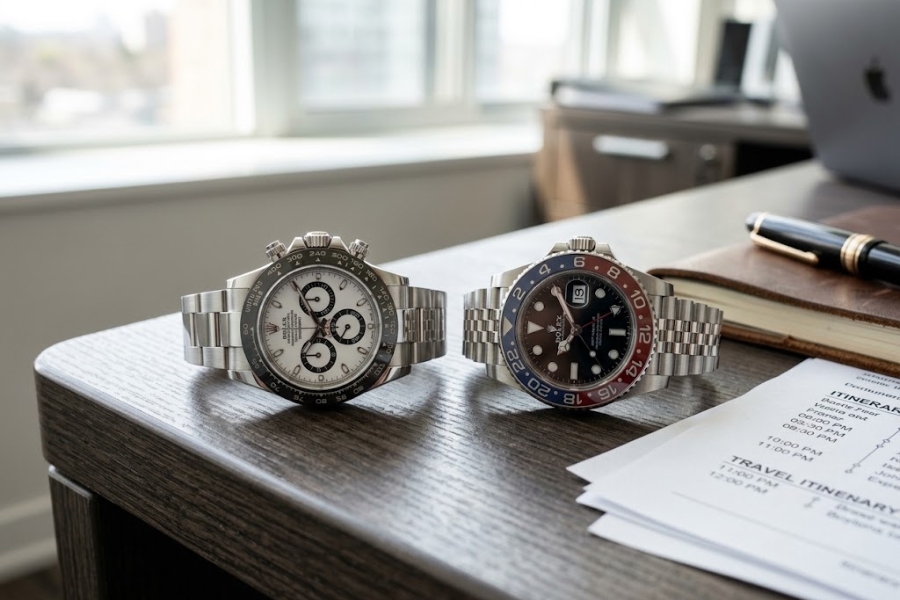
To truly understand this debate, we must look at the two most coveted models in the luxury watch market. The Rolex Cosmograph Daytona and the Rolex GMT-Master II represent the absolute pinnacle of their respective categories.
The Rolex Daytona is the ultimate status symbol. It features a highly complex column-wheel chronograph movement. Because production numbers are heavily restricted, the Daytona carries an astronomical premium on the secondary market. It projects pure success and motorsport glamour. However, due to its screw-down pushers, you have to physically unscrew the locks before you can even start the stopwatch, making it slightly cumbersome for quick, spontaneous timing.
The Rolex GMT-Master II, conversely, is the ultimate high-end tool watch. Available in iconic ceramic bezel variations, it offers massive daily utility for international professionals. If you are struggling to choose which configuration fits your style, read our definitive showdown between the Rolex GMT-Master II Batman vs. Pepsi. If you are curious about the origins of these famous bezel colors, you can also explore our guide on how Rolexes got their iconic nicknames.
| Complication Category | Primary Advantage | Primary Disadvantage | Best Suited For |
|---|---|---|---|
| The Chronograph | Tactile interaction and ability to track elapsed physical events instantly. | Higher servicing costs and occasionally cluttered dial legibility. | Motorsport fans, cooks, and medical professionals measuring pulse rates. |
| The GMT (Flyer) | Ability to instantly jump local hours when crossing international borders. | Thicker case profile required to house the complex jumping hour module. | Frequent international travelers and global sales executives. |
| The GMT (Caller) | Highly practical for tracking a secondary market from home. | Cumbersome to reset the main local time when traveling across borders. | Remote workers, traders, and individuals with family living overseas. |
Both models hold their value incredibly well. If you are buying strictly as an alternative asset, we highly recommend reviewing our analysis of Rolexes that will make you money to understand the depreciation curves of these specific models.

Community Insights: What Do Collectors Actually Use
When we pull back the curtain and look at how real collectors use their watches, the debate becomes highly subjective but incredibly telling. Here are genuine insights pulled directly from active enthusiast communities regarding daily complication usage.
Regarding the tactile romance of the chronograph:
“I use my Speedmaster to time my laundry and my steaks on the grill. It is essentially an $8,000 egg timer, but the tactile feel of clicking those pushers is why I bought it. It is about mechanical interaction, not necessity.” – Reddit r/Watches Community
Regarding the passive, daily utility of a well-made GMT watch:
“I live in Toronto but manage a team in London. My Tudor Black Bay Pro gets used every single day without me even pressing a button. A true flyer GMT is hands down the most practical complication a modern professional can own.” – Reddit r/Tudor Community
Maintenance And Servicing Costs
Before making a final decision, you must factor in the hidden cost of mechanical watch ownership: routine servicing. Adding any complication to a watch increases the number of moving parts, which inherently increases the labor required to service the caliber.
Chronographs are notoriously expensive to maintain. A modern chronograph movement contains dozens of delicate levers, springs, and gears that must interact perfectly. Furthermore, the architecture of the chronograph matters. As explained in Rolex’s Daytona technical documentation, watches utilizing vertical clutches and column wheels are far superior in performance, but they require master watchmakers to service.
A GMT movement, while complex, is generally far closer in architecture to a standard three-hand date watch. Consequently, a GMT will almost always be cheaper and faster to service than a chronograph from the exact same luxury brand.

If you are planning your long-term ownership budget, we strongly encourage you to read our guide on how often you should service your Rolex to understand the financial realities of maintaining a highly complicated mechanical movement.
The Toronto Watch Exchange Verdict
Deciding between a chronograph and a GMT is the ultimate test of a collector’s self-awareness. You must objectively evaluate how you live your life, rather than how a marketing campaign tells you to live it.
Buy a Chronograph if you deeply appreciate the romance of mechanical engineering. If you find joy in physically interacting with your watch, timing mundane daily events, and staring at the dense, technical layout of sub-dials, nothing will bring you more satisfaction than a Speedmaster or Daytona.
Buy a GMT if you prioritize passive utility and practical daily data. If you communicate across borders, manage remote teams, or frequently step onto airplanes, a GMT will become an indispensable daily tool that you rely on constantly without ever having to push a button.
Regardless of which complication you choose, secondary-market prices may be above or below retail and vary by reference, condition, completeness and current demand. Compare the specific watch with current retail pricing and recent market transactions. Browse our heavily curated, fully authenticated inventory of luxury chronographs and GMTs at the Toronto Watch Exchange Shop to find the perfect complication for your daily lifestyle.