
You go to set the time on your Submariner or Datejust. You push the crown in and begin to turn it, but something feels wrong. It stops short. You look closely and see a tiny sliver of space between the crown and the case. Panic sets in. Has it been broken? Is the Rolex crown screw-down mechanism stripped? Is your watch still waterproof?
Before you reach for a pair of pliers (please, never do that), take a deep breath. At Toronto Watch Exchange, we see this issue almost daily. In many cases, what you are seeing is a design feature, not a defect. However, if you force it, you can turn a minor quirk into a $1,000 repair bill.
This guide explains why your Rolex watch crown might not sit flush, the difference between a “Triplock” gap and a broken tube, and how to safely troubleshoot the issue at home.
Understanding the Rolex Crown Screw-Down Mechanism
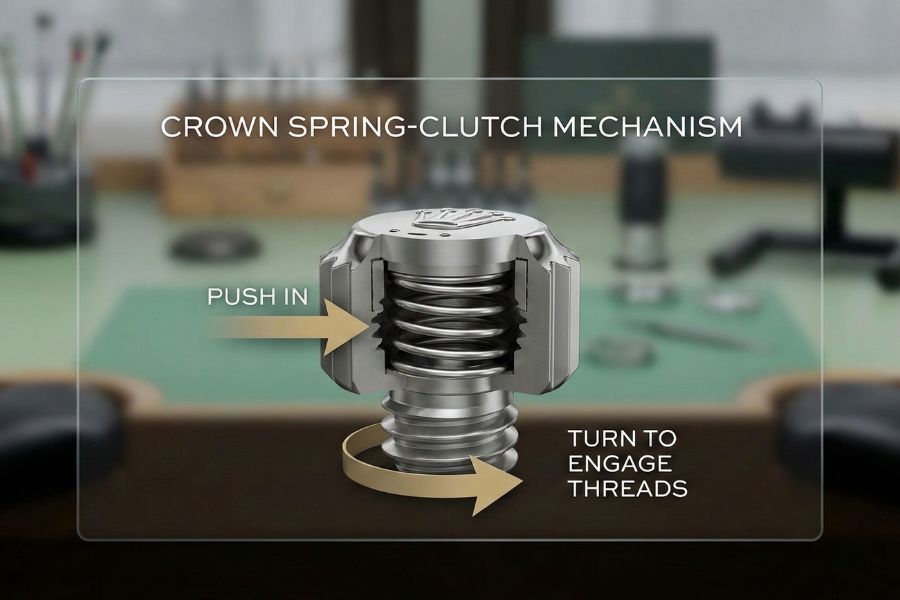
The winding crown is the primary interface between you and your watch’s movement. On a waterproof Oyster case, this component is far more complex than a simple knob. It is a spring-loaded clutch system designed to decouple from the movement when screwed down.
When you push the crown in, you are compressing a spring. This spring provides the outward pressure necessary to keep the threads engaged. If the Rolex crown screw-down threads are blocked or if you are not applying enough inward pressure, the crown will pop back out to the winding position. This safety feature prevents you from accidentally grinding gears, but it can also be a source of frustration for new owners.
Differences Between Twinlock and Triplock Crowns
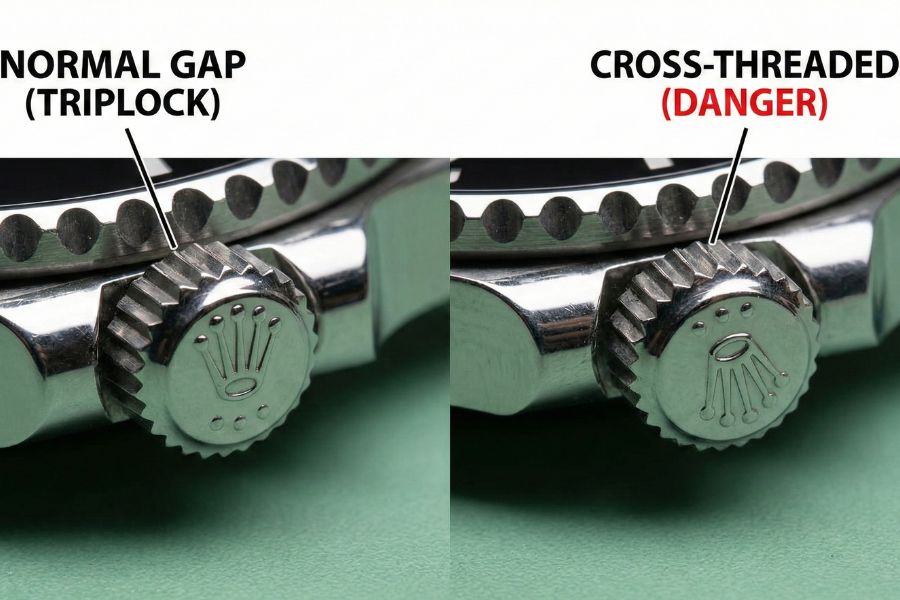
The most common reason owners panic about a gap is that they do not realize which crown system their watch uses. Rolex watches employ two primary waterproof systems: the Twinlock and the Triplock. They look different and fit differently.
The Twinlock system (found on the Datejust, Oyster Perpetual, and Explorer) is designed to sit relatively flush against the case. However, the Triplock system (found on the Submariner, GMT-Master II, and Daytona) is a different beast entirely. Because of the sheer amount of rubber seals inside a Triplock crown (four distinct zones), there is often a microscopic “buffer zone” even when fully tightened.
Rolex Crown Identification Table
| Feature | Twinlock Crown | Triplock Crown |
|---|---|---|
| Models | Datejust, Explorer, OP | Submariner, GMT, Daytona |
| Markings | Line (-) or Dots (..) | Three Dots (…) |
| Visual Fit | Sits Flush | Often has a slight visible gap |
| External Seal | Hidden inside the tube | Visible black O-ring on tube |
The Reality: If you have a sports model like a Submariner, seeing a hairline gap is often normal. The waterproof seal happens inside the tube, not just where the metal crown touches the metal case. As long as the crown is finger-tight and the threads have caught, your Rolex crown screw-down seal is likely intact.
Common Reasons Your Rolex Crown Will Not Screw Down
If your crown physically refuses to screw in, do not force it. The threads on a Rolex case tube are precise, but they can be blocked by debris. Here are two common culprits that don’t require a visit to a watchmaker.
Debris and Dirt in Case Tube Threads
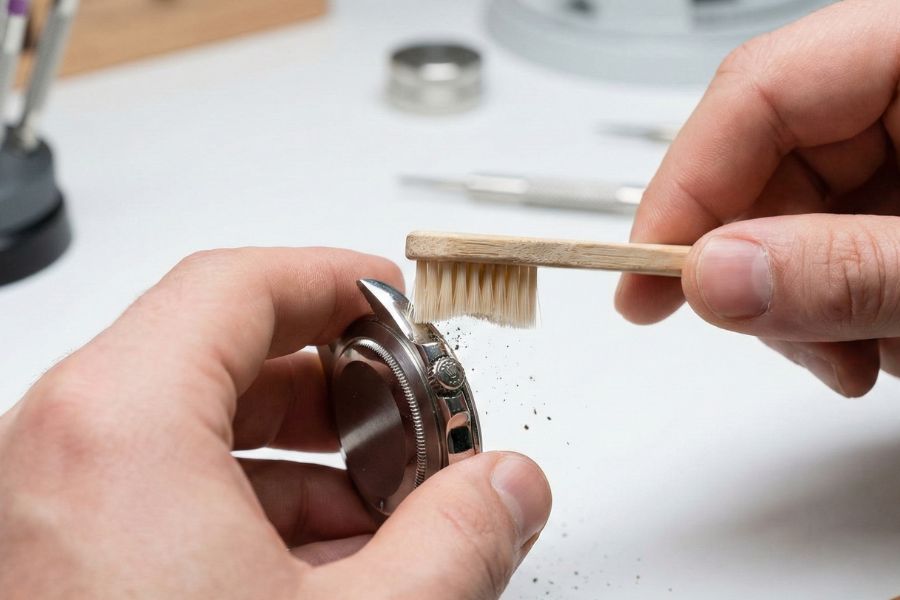
Over months of wear, a mixture of dead skin cells, lotion, and dirt accumulates on the threads of the case tube. This “wrist gunk” hardens and acts like a stopper, preventing the crown from screwing down the final millimeter. This is especially common if you wear your watch to the gym or in humid environments. To prevent this buildup, we recommend following our step-by-step guide on how to clean your luxury watch.
- The Fix: Use a soft-bristled toothbrush (dry) to gently sweep the threads of the tube while the crown is unscrewed. Do not use water or solvents, as you risk getting moisture into the open tube.
Fighting the Spring Tension
Because the crown is spring-loaded, you must push in against the spring pressure while simultaneously turning it clockwise to engage the threads. If you release the inward pressure too early, the threads will disengage, and the crown will pop back out.
Pro Tip: To ensure proper thread alignment, push the crown in and turn it counter-clockwise (backwards) first. You will feel a small “click” as the threads align. Once you feel that click, begin turning clockwise to screw it down.
Mechanical Failures Preventing Proper Crown Closure
While stiffness or debris is manageable, “grittiness” is not. Two major mechanical failures require immediate professional attention. If you experience these symptoms, stop turning immediately.
Cross-Threading the Case Tube
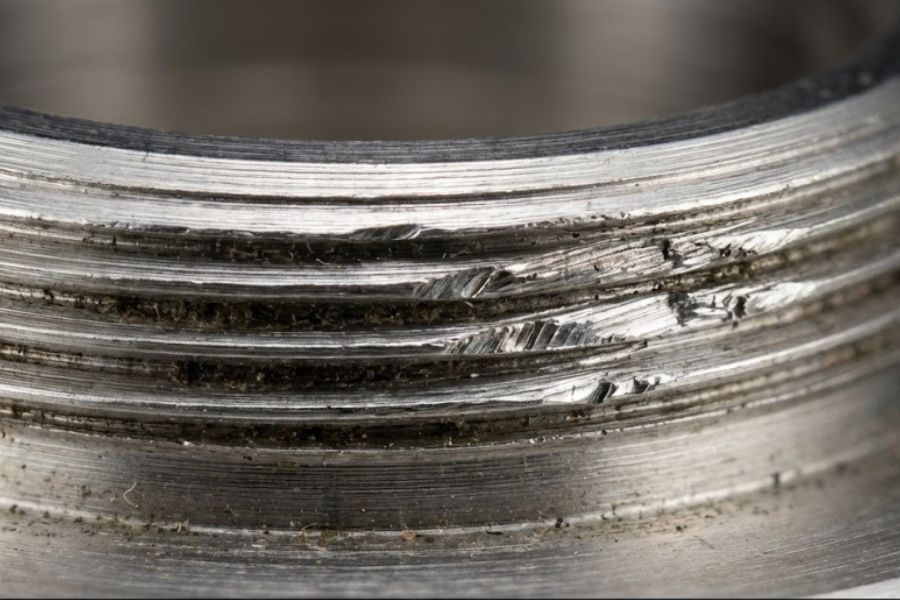
This is the silent killer of Rolex cases. It happens when you try to screw the crown down at a slight angle. You are effectively forcing the steel threads of the crown to cut new paths into the steel threads of the tube.
- The Symptom: The crown turns about half a turn and then gets stuck solid. It feels like it hit a wall.
- The Risk: If you grab a shirt or pliers to force it, you will permanently strip the tube. This requires drilling out the old tube and installing a new one.
Stripped Crown Internal Threads
This is common on older vintage models where the crown was capped with gold or softer steel. Over decades of winding, the internal threads wear smooth.
- The Symptom: The crown pushes in all the way, but it spins endlessly. It never “catches” or locks into place.
- The Risk: Your watch has zero water resistance. Even humidity from the air can enter the movement and rust the dial and hands.
The After-Service Stiffness Phenomenon
We often hear from clients who just picked up their watch from a service center and worry that the crown feels “different.” They complain that the Rolex crown screw-down action is stiff or requires more force than before.
Actually, this is usually a good sign. During a full service, the rubber gaskets in the crown and tube are replaced. Fresh rubber is stiff and requires more torque to compress than old, worn-out rubber. If your crown feels firm and “mushy” at the end, it means your gaskets are doing their job, creating a tight, waterproof seal.
Rolex Crown Repair Costs in Canada
If you have stripped your threads, the repair involves more than just swapping a part. The case tube is permanently screwed (and Loctited) into the watch case. To replace it, a watchmaker must remove the movement, dial, and hands to access the inside of the case.
Here is what you can expect to pay for repair in the Toronto market in 2026. Prices vary based on whether you use the official Rolex Service Center (RSC) or an independent specialist like Toronto Watch Exchange.
| Service Component | Rolex Service Center Estimate (CAD) | Independent Watchmaker Estimate (CAD) |
|---|---|---|
| Case Tube Only | Not Offered (Requires Full Service) | $150 – $250 (Labor Incl.) |
| New Monobloc Crown | Included in Service Cost | $300 – $500 (Part Only) |
| Full Movement Service | $1,200 – $1,500+ | $600 – $900 |
Warning on Generic Parts: Many unqualified repair shops use $20 aftermarket tubes. These are made of inferior steel, rust quickly, and often fail pressure tests. We use only authentic components to ensure your timepiece retains its value and integrity.
When to Repair vs Sell Your Rolex
Facing a repair bill of over $1,000 for a stripped crown can be frustrating. For many owners, this is the moment they decide to upgrade their timepiece rather than sink money into maintenance.
If your watch requires a full service alongside the crown repair, the total cost can exceed $1,500. In these cases, selling the watch “as-is” might be the smarter financial move. At Toronto Watch Exchange, we buy watches in need of repair because we can service them in-house at wholesale cost. If you are considering this option, check out our guide for luxury watch sellers to understand how condition affects value.
Immediate Safety Steps for Loose Crowns
So, is it safe to wear your watch if the crown won’t screw down? The answer depends on the severity of the gap.
- Gap but Tight: If the crown is screwed down tight but has a visible gap (common on Triplock), it is likely safe.
- Spins Freely: If the crown spins without catching, it is unsafe. Do not wear it near water, steam, or heavy rain.
- Stuck Halfway: If it is cross-threaded, do not force it further. Leave it as is and bring it in for repair.
Before you commit to a potentially unnecessary full service, bring your watch to Toronto Watch Exchange. We can perform a quick thread check and a dry pressure test in minutes. We will tell you if it’s just “new gasket stiffness” or if you need a tube replacement.
Don’t force it. Let us check it. Visit us today to ensure your Rolex remains the waterproof tool it was built to be.

Written by