
The distinctive crown of the watch, the classy dial, or the shiny bracelet might be the first things that catch your eye when you look at a Rolex watch. However, if you’ve ever held one in your hands, you’ve most likely fiddled with the ring that encircles the crystal, called the bezel. Exactly what is it used for, you might have thought? Is it merely for aesthetic reasons? And why do some remain fixed while others turn?
We at Toronto Watch Exchange have assisted thousands of individuals in understanding the subtleties of premium watches, and we know that the bezel is much more than just aesthetic appeal. It’s a calibrated device that was frequently developed out of practical need, whether it be on a racetrack, underwater, or when traveling across time zones. In this guide, we’ll break down every true Rolex bezel type, how each one functions, and which models use them.
Why Rolex Doesn’t Just “Add” Bezels, They Engineer Them for Purpose
Rolex approaches the bezel not as an accessory but as a functional extension of the watch itself. Unlike fashion brands that treat bezels as decorative borders, Rolex designs theirs to solve specific problems. A diver needs to track oxygen. A pilot needs to read a second time zone. A racecar driver must calculate speed. Each bezel type answers one of these needs with precision engineering, durable materials, and ergonomic design.
This philosophy explains why Rolex bezels are either fixed or rotating, but never arbitrary: The bezel has a click mechanism, a calibrated scale, and rotates in a specific direction. If it’s fixed, it’s because adding movement would interfere with the watch’s functionality or aesthetic appeal. Knowing this enables you to select the ideal Rolex for your way of life without overspending on features you won’t utilize.
The Four Rolex Bezel Types
Currently, Rolex employs four different bezel types in both its classic and professional collections. Each has a distinct function, shows up on particular models, and is the result of decades of development.
1. Unidirectional Rotating Bezel: The Diver’s Lifeline
Found on: Submariner, Sea-Dweller, Deepsea
Perhaps Rolex’s most important safety innovation is the unidirectional rotating bezel. It uses a 60-minute scale to measure elapsed time and was made for diving. The most important safety feature? It only makes counterclockwise rotations. Why? The bezel will display more elapsed time, not less, if it shifts unintentionally during a dive, for example, by hitting coral. By taking the cautious route, this mistake keeps a diver from coming to the surface too soon and running the risk of developing decompression sickness.
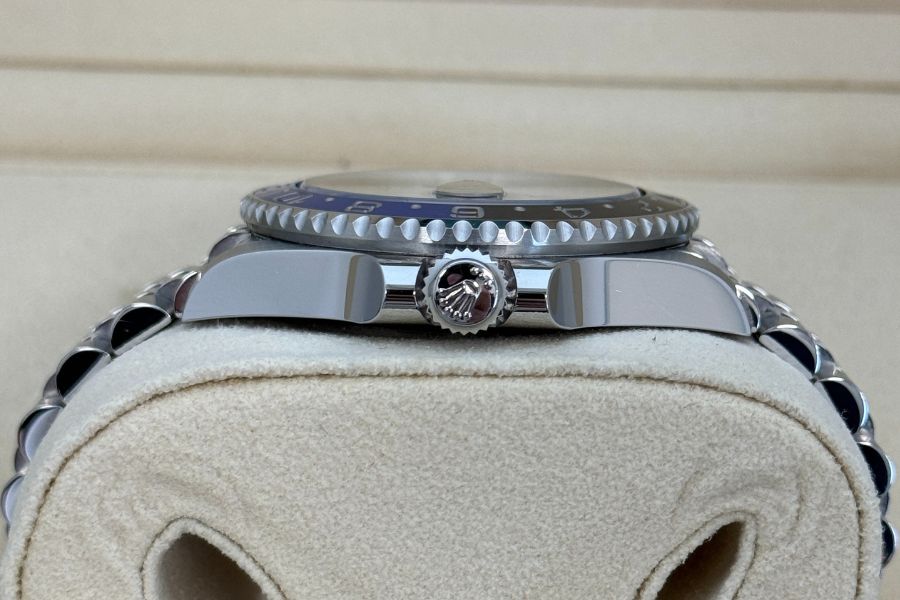
Before descending, you set it by lining up the minute hand with the zero marker, which is typically a luminescent pip. The minute hand on the bezel indicates the amount of time that has passed as the dive continues. On the Deepsea model, the entire system is mechanical, battery-free, and dependable at depths of more than 1,000 meters.
2. Bidirectional Rotating Bezel: Mastering Two Time Zones at Once
Found on: GMT-Master, GMT-Master II
Frequent travelers and shift workers love this one. The bidirectional 24-hour bezel lets you track a second time zone independently of your local time. The GMT-Master II takes it further with its independently adjustable hour hand, meaning you can change time zones without stopping the watch or losing accuracy.
Here’s how it works: the 24-hour scale on the bezel aligns with the red or green GMT hand (which makes one full rotation every 24 hours). Set your home time to the GMT hand, align the correct hour on the bezel, and your local time stays on the main hour hand. Rotate the bezel clockwise or counterclockwise to switch time zones instantly, no calculations needed.
Rolex transitioned from aluminum to Cerachrom ceramic for these bezels in 2007 (GMT-Master II) and 2013 (full colour options), making them virtually scratch-proof and fade-resistant.
3. Tachymeter Bezel: Calculating Speed Without a Smartphone
Found on: Daytona
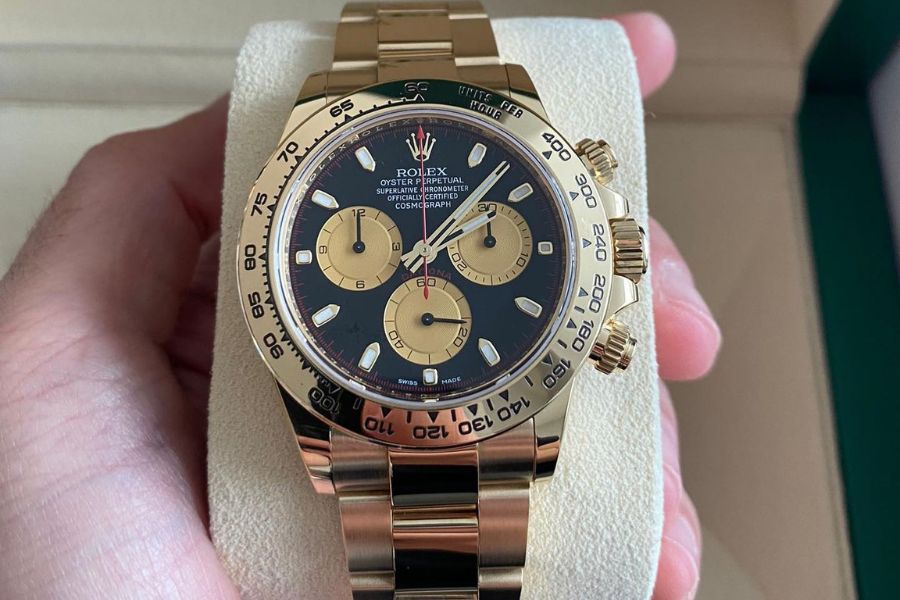
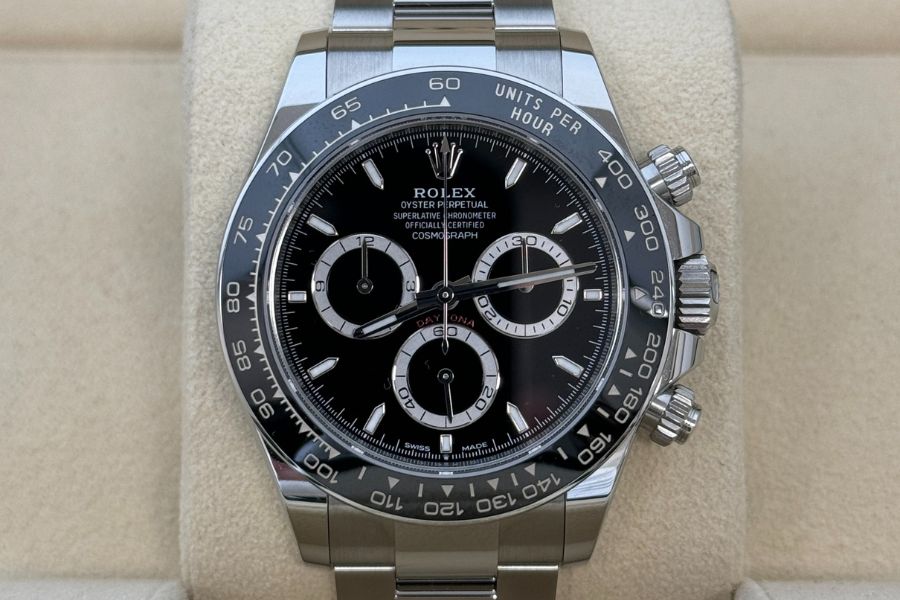
The Daytona’s fixed tachymeter bezel is a relic of analog race timing. Paired with the chronograph (stopwatch) function, it lets you measure average speed over a known distance, say, one kilometer or one mile.
Start the chronograph at the beginning of the distance, stop it at the end, and where the chronograph’s seconds hand lands on the tachymeter scale is your speed in km/h or mph. For example, if it takes 30 seconds to travel one mile, the hand points to 120, meaning 120 mph. It’s a simple, mechanical solution that predates GPS and radar guns, yet remains beloved by motorsport enthusiasts.
4. Fixed Bezel: When Beauty Meets Structure
Found on: Datejust, Day-Date, Oyster Perpetual, Lady-Datejust
These bezels don’t rotate, and they’re not supposed to. On models like the Datejust or Day-Date, the bezel is purely aesthetic or structural.
Not all Rolex bezels rotate. On the Datejust, Day-Date, and Oyster Perpetual, the bezel is fixed, and that’s intentional. These watches aren’t designed for timing dives or tracking flights, they’re designed to be worn in boardrooms, at dinners, and on formal occasions. The bezel here is part of the watch’s identity.
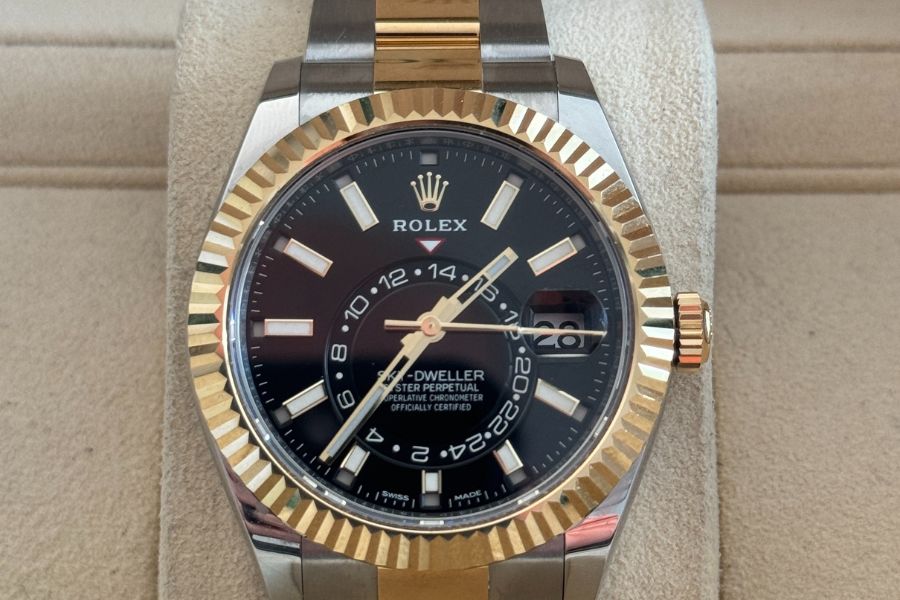
The fluted bezel, often made of 18k gold or platinum, was originally designed to screw into the case and improve water resistance. Over time, it became a symbol of refinement. Rolex still uses the exact same groove pattern today, and it’s one of the most copied features in luxury watches, but never perfectly replicated.
Common styles include:
- Fluted bezel: Originally designed to improve grip when screwing down the crystal, now a signature elegance detail, often in gold
- Smooth bezel: Minimalist, modern, available in steel, gold, or platinum
- Diamond-set bezel: Adds luxury, commonly seen on women’s or high-end models
While they lack functionality, fixed bezels contribute significantly to a Rolex’s identity. The fluted bezel alone is so iconic that Rolex patents its exact groove geometry.
Different Rolex Bezel Materials
Beyond function, the material affects durability, appearance, and resale value. Rolex has evolved from soft aluminum inserts (1950s–2000s) to high-tech Cerachrom ceramic (2005 onward).
Aluminum bezels develop a unique patina over time. Some collectors love this vintage charm; others see it as wear. Ceramic, by contrast, resists scratches, UV fading, and chemical corrosion. Early ceramic versions were only black or blue, but Rolex now produces two-tone Cerachrom (like the “Pepsi” red-and-blue GMT) using a patented gas-phase deposition process.
| Bezel Material | Used In Which Models | Durability Level | Fade Resistance | Collector Appeal | Maintenance Tips |
|---|---|---|---|---|---|
| Aluminum Insert | Vintage Submariner, early GMT-Master | Moderate | Low – prone to fading in sunlight | High – especially faded “Pepsi” or “Coke” variants | Avoid direct sun exposure; clean gently; patina is valued by collectors |
| Cerachrom Ceramic | Modern Submariner, GMT-Master II, Deepsea | Extremely High | Excellent – color embedded during manufacturing | Very High – sharp colors, long-lasting condition | Wipe with soft cloth; resistant to scratches and UV damage |
| Metal with Printed Scale | All Daytona models (chronograph) | High – but surface print can wear | Medium – ink may fade over decades | Very High – especially on vintage Paul Newman dials | Do not use chemicals; avoid abrasive cleaning tools |
| 18k Gold or Platinum (Fluted) | Datejust, Day-Date, Pearlmaster | Very High – metal won’t degrade | N/A – no color layer | High – matching metal sets premium value | Clean between grooves with soft brush; avoid polishing which removes material |
| Gem-Set Bezel (Baguette or Round-Cut) | Rainbow Day-Date, Pearlmaster, special editions | High – stones set in solid gold | N/A – depends on stone quality | Extremely High – rarest of all, auction favorites | Professional cleaning only; check for loose stones annually |
If you’re selling a Rolex, a pristine ceramic bezel can add thousands to its value. A cracked or faded aluminum one may signal heavier use, something buyers notice instantly during appraisal.
How to Care for Your Rolex Bezel (And Keep It Looking New)
Even the toughest Cerachrom can accumulate grime in the numerals or scratches from daily wear. Clean gently with a soft cloth and mild soapy water. Avoid abrasive cleaners or toothbrushes, they can dull the finish.
If your rotating bezel feels stiff, don’t force it. Modern Rolex bezels use Teflon-based lubricants sealed during assembly. Adding oil or trying to “loosen” it can attract dust and degrade performance. Check the guide for proper cleaning steps for your Rolex. If it’s truly stuck, bring it to a certified watchmaker.
- For ceramic bezels, clean with a soft microfiber cloth and lukewarm water. Avoid harsh chemicals, abrasive brushes, or ultrasonic cleaners. Even though ceramic resists scratches, it can chip if struck against hard surfaces.
- For aluminum bezels, gentle cleaning is fine, but expect some patina over time. Many collectors view this as part of the watch’s story. If you want to preserve the original look, store your watch away from direct sunlight and avoid contact with sand or gravel.
- For fluted or diamond-set bezels, use a soft toothbrush to gently clean between the grooves. Never use toothpaste or metal polish, they can damage the finish.
And if your bezel feels loose, stiff, or doesn’t click properly, don’t try to fix it yourself. Rolex bezels are fitted with extreme precision. A misaligned bezel can affect the water resistance of the entire watch. Take it to a certified service center.
Which Rolex Bezel Is Right for Your Lifestyle?
If you’re choosing your first Rolex, match the bezel to your real-world needs:
- Travel often? GMT-Master II gives you dual time zones with minimal effort.
- Dive or swim regularly? Submariner’s unidirectional bezel is both functional and iconic.
- Love vintage aesthetics? Aluminum bezels on older GMTs or Subs offer character, but expect some wear.
- Prefer elegance over utility? Datejust’s fluted bezel delivers timeless sophistication.
| Rare & Collectible Bezel Variants | Era Produced | Estimated Rarity | Average Market Value Increase | Why Collectors Want It |
|---|---|---|---|---|
| “Root Beer” GMT-Master (brown/gold ceramic) | 1990s – early 2000s | Very rare – limited production run | 2x to 3x standard model price | Unique earth-tone colorway before modern “Root Beer” reissue |
| “Coke” Bezel (red/black aluminum) | 1970s – 1985 | Rare – replaced by “Batman” | Up to 50% above similar condition models | Pre-ceramic era favorite; nostalgic appeal among vintage buyers |
| “Bakelite” Bezel (early GMT-Master) | 1955 – 1960s | Extremely rare – fragile material | Auction-only, values vary widely | First-generation material; highly sought after despite fragility |
| Faded “Pepsi” Bezel (aluminum, tropical dial) | 1960s – 1980s | Scarce – natural aging required | Can double value if original and unpolished | “Tropical” fade is organic and irreversible; authenticity is key |
| “Rainbow” Bezel (multi-colored sapphires) | 2017 – present (limited releases) | Ultra-rare – hand-set stones | 3x to 5x retail at auction | One of the most extravagant Rolex watches ever produced |
And if you’re selling a Rolex, knowing your bezel type helps us give you a more accurate appraisal. We also verify authenticity by checking serial numbers, case back engravings, and bezel construction, so you get fair market value without guesswork.
The Hidden Details That Separate Real from Fake Bezels
Counterfeiters often miss subtle cues:
- Genuine Cerachrom bezels have perfectly crisp numerals with no paint fill, they’re molded in colour.
- The zero pip on a Submariner glows with the same Super-LumiNova as the hands and markers.
- On the GMT-Master II “Batman,” the sharp colour split between blue and black is achieved through a single-piece ceramic process, fakes use two glued halves.
These details matter if you’re buying a used Rolex. Always inspect the bezel closely under magnification, or bring it to a trusted dealer like us for authentication.
What to Look for in a Rolex When Buying or Selling
If you’re considering purchasing a Rolex, start by looking at the bezel. Does the shade remain constant? Do the numbers make sense? Does the rotation appear smooth and precise? On vintage models, keep an eye out for fading, especially on the aluminum inserts. On a GMT-Master, a faded bezel may increase the value, but on a Submariner, it may decrease it, depending on the color and rarity.
Understanding the bezel enhances your appreciation, whether you’re trying to figure out how the ring around your watch works, looking up a serial number before purchasing, or preparing to sell a Rolex. Furthermore, in a world where smartwatches are updated monthly, a mechanical tool that has been in use for 70 years, refined, yes, but never compromised, has a certain power.
We observe these details on an everyday basis at Toronto Watch Exchange. Given this, a Rolex watch not only tells the time but also acquires trustworthiness. And we’re here to make it easy, reasonable, and genuine if you ever need assistance acquiring, celebrating, or separating with one.