
You have finally found the perfect vintage timepiece. The dial is flawless, and the bezel has the exact faded patina you wanted. But when you pick the watch up off the table, the metal band flops over like a wet noodle. This is what collectors call Rolex bracelet stretch, and it is the single most overlooked issue when buying on the secondary market.
At Toronto Watch Exchange, we inspect hundreds of pre-owned luxury pieces every single year. We see buyers get incredibly excited about a great price, only to realize they just bought a watch that needs thousands of dollars in hidden repairs.
This guide is going to walk you through exactly how to measure and identify Rolex bracelet stretch so you can buy your next timepiece with total confidence.
The Hidden Cost of Buying a Worn-Out Rolex Band
Many newcomers to the watch community think that a loose band is just a cosmetic quirk of vintage watches. They assume it adds character. The reality is that a heavily worn band is a structural failure waiting to happen. If you ignore this condition, you are risking the safety of the entire watch. A loose band can suddenly snap under pressure, sending your expensive watch head crashing onto the concrete sidewalk.
Beyond the physical danger to the watch, there is a massive financial trap. Sellers often discount watches with terrible bands, making them look like a bargain. However, the cost to restore or replace these parts has skyrocketed in recent years. What looks like a five-hundred-dollar discount might actually hide a two-thousand-dollar repair bill. You have to factor the condition of the metal directly into your negotiation strategy.
The Core Reasons You Must Inspect Before Buying
- Risk of Catastrophic Failure: Worn pins can snap without warning and drop the watch.
- Loss of Resale Value: Future buyers will deduct the cost of repair from their offer.
- Poor Wrist Comfort: A stretched band pinches arm hair and slides uncomfortably around your wrist.
- Expensive Restoration Costs: Fixing the metal requires highly specialized laser welding from master jewelers.
Cost Comparison for Repairing or Replacing Bands
| Solution Type | Stainless Steel Cost | Solid Gold Cost |
|---|---|---|
| Independent Laser Welding Repair | Roughly $800 to $1,200 | Roughly $1,500 to $2,500 |
| Brand New Replacement via Rolex | Roughly $1,500 to $2,000 | Easily $10,000 to $15,000+ |
| Buying a Used Replacement Band | Roughly $1,000 to $1,500 | Roughly $5,000 to $8,000 |
Does a stretched band ruin the watch completely?
No, the watch itself is perfectly fine. The internal mechanical movement and the waterproof case are completely separate from the band. You can always remove a ruined band and put the watch on a high-quality leather strap or a rubber dive strap. The issue is simply that the original factory metal has lost its integrity, which heavily impacts the total collector value of the package.
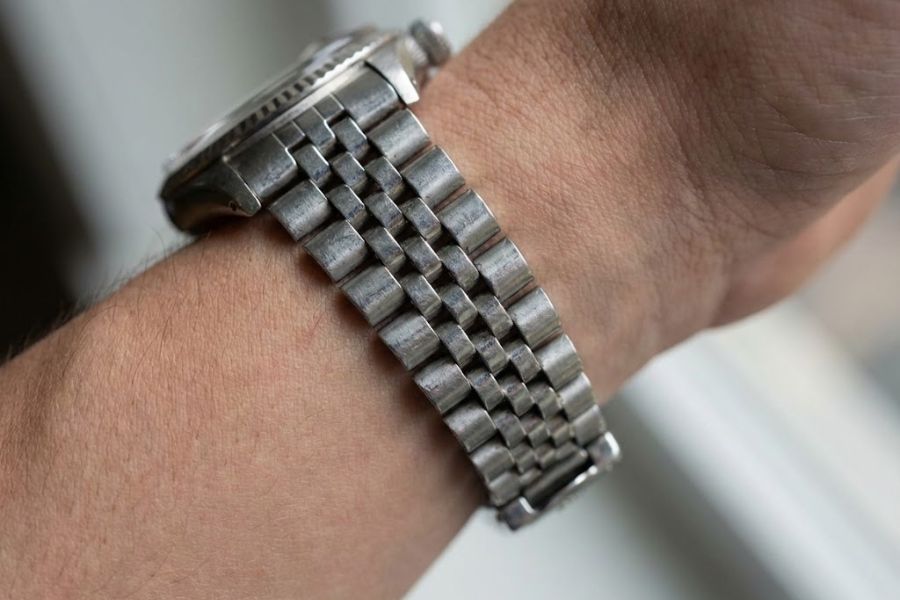
Understanding How Metal Actually Degrades Over Time
There is a massive misconception in the watch world about how the Rolex bracelet stretch actually happens. Most people imagine the steel or gold is physically stretching out like a rubber band being pulled too hard. That is physically impossible under normal human wear. The structural integrity of a luxury watch bracelet relies entirely on the tiny metal pins and screws that hold the individual links together.
What actually happens is a process called pinhole elongation. As you wear your watch every day, microscopic particles of dirt, dust, and dead skin cells get trapped between the links. When this grime mixes with your natural skin oils, it creates a dark, abrasive paste. Every time you move your wrist, this paste acts exactly like liquid sandpaper. It slowly grinds away the metal pins and widens the holes they sit inside. This missing metal creates gaps, and those gaps create the floppy looseness we call stretch.
The True Culprits Behind the Damage
- Trapped Dirt and Grit: The abrasive paste grinds down the internal steel pins daily.
- Wearing the Watch Too Loose: A loose fit allows the heavy watch head to hammer against the pins every time you move your arm.
- Lack of Routine Cleaning: Failing to wash the band allows the abrasive grit to build up and harden.
- Natural Softness of Precious Metals: Gold and platinum wear down much faster under friction than hard stainless steel.
Stages of Wear Inside the Metal Pins
| Wear Stage | Physical Condition Inside the Link | Visible Symptoms |
|---|---|---|
| Stage 1: Factory Fresh | Pins are perfectly round and holes are tight | Zero gap between links and no side-to-side play |
| Stage 2: Mild Wear | Pins begin to flatten on one side due to friction | Slight flexibility and a tiny bit of droop when held sideways |
| Stage 3: Moderate Damage | Pins are significantly grooved, and holes are oval-shaped | Noticeable gaps between links and visible horizontal droop |
| Stage 4: Severe Failure | Pins are worn down to a thread and ready to snap | Band flops at a sharp 90-degree angle and feels incredibly loose |
Is the metal actually stretching like a rubber band?
Absolutely not. The metal is not stretching at all. The metal is actually disappearing. The friction turns the solid steel or gold pins into microscopic metal dust that washes away. The extra length you feel in a stretched band is simply the accumulated empty space of all those widened holes and worn-down pins adding up across twenty different links.
Performing the Famous Horizontal Droop Test at Home
You do not need to be a professional watchmaker with special tools to test for this issue. The global watch community relies on a very simple physical evaluation known as the horizontal droop test. You can do this in ten seconds at any jewelry counter or meetup before you decide to buy.
To perform the test, you must take the watch off your wrist. Hold the watch entirely by the watch head (the case) so the dial is facing the ceiling. Hold it out in front of you so it is perfectly parallel to the floor. Now, simply look at how the metal band behaves. A brand new, tight band will stick straight out like a diving board. A band suffering from severe Rolex bracelet stretch will immediately droop down toward the floor under its own weight. Just like diagnosing a Rolex running slow or investigating a sudden Rolex running fast due to magnetism, you need to understand the physical mechanics of the band before you hand over your credit card.
Exactly How to Evaluate the Wear Levels
- Hold by the Case Only- Do not support the band with your fingers while doing the test.
- Observe the Angle- Note exactly how many degrees the band drops away from the horizontal line.
- Check the Link Gaps- Look closely at the spaces between the metal links while it hangs to see the widened holes.
- The Wiggle Test- Lay the watch flat on a soft table and gently try to curve the band side to side like a snake.
Horizontal Test Angle Meaning Guide
| Droop Angle | Condition Rating | Buying Recommendation |
|---|---|---|
| 0 to 15 Degrees | Excellent to Mint | Buy with confidence. The pins are thick and healthy. |
| 15 to 35 Degrees | Good to Fair | Normal for a vintage piece. Price should reflect minor wear. |
| 35 to 60 Degrees | Poor | Needs repair soon. Demand a significant discount. |
| 60 to 90 Degrees | Severe Damage | Walk away or immediately send to a specialist for laser welding. |
Can I test this condition through photos online?
Yes, you can, provided the seller is honest. Whenever you are buying a used piece online, you must demand that the seller provide a clear photo of the watch horizontally. If a seller refuses to show you the horizontal droop test photo, they are almost certainly hiding a severely damaged band. Never buy a vintage piece online without seeing this specific angle.
Why Some Designs Suffer More Wear Than Others
Not all designs are created equal when it comes to durability. If you are browsing our incredible selection of Rolex watches, you need to know how different styles age. The brand has produced three legendary band designs over the last century, and each one reacts to friction in a completely different way.
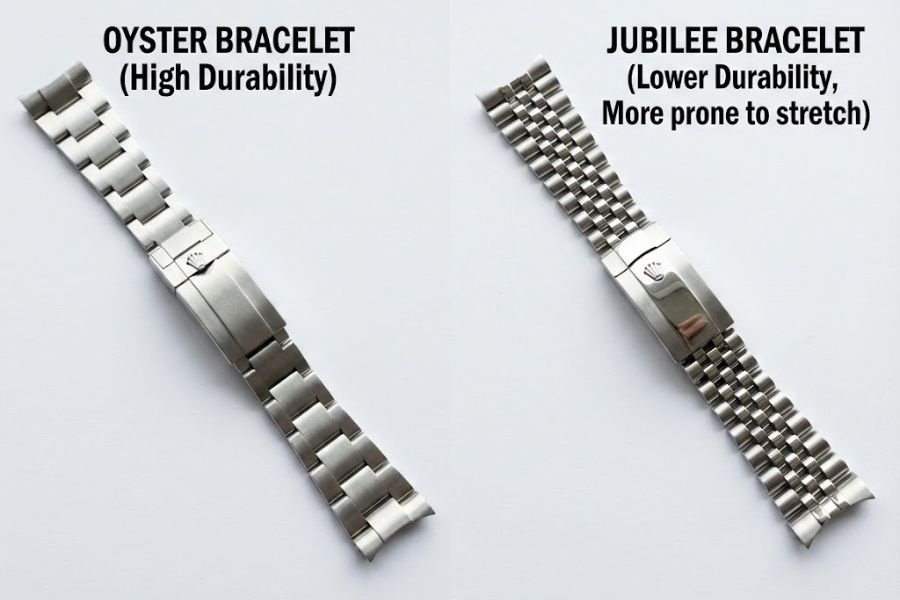
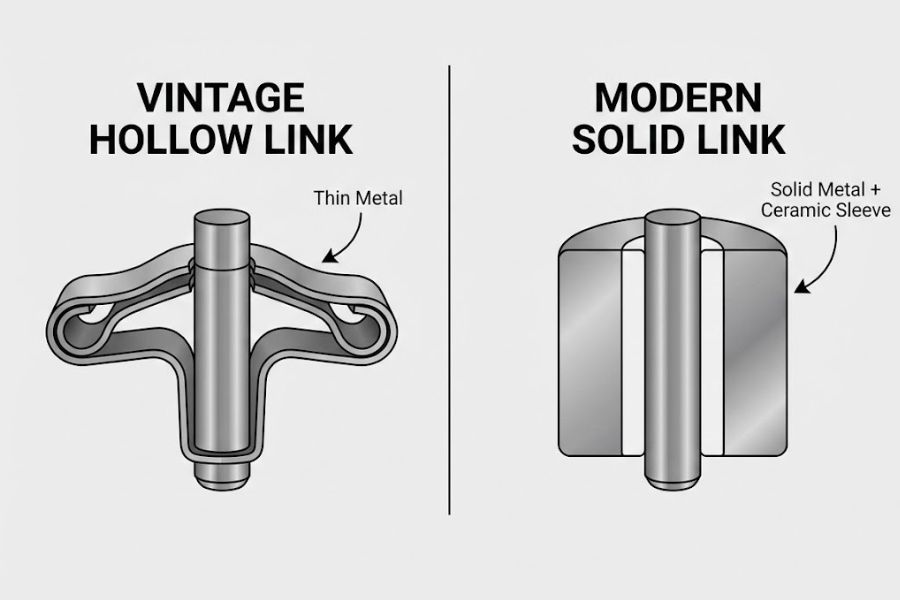
The iconic Jubilee style is the most famous for developing severe droop. Because it features five small metal pieces per link, there are dozens of tiny moving parts and friction points. Older vintage models used hollow, folded metal instead of solid steel, making them incredibly fragile. On the opposite end of the spectrum is the Oyster style. With its wide, flat, three-piece construction, it has far fewer moving parts and can withstand decades of abuse before showing serious wear.
The Most Vulnerable Styles in the Catalog
- Vintage Hollow Jubilee: The absolute worst offender due to thin metal and high friction points.
- Solid Gold President: The heavy gold links are incredibly soft and grind each other down very quickly.
- Two Tone Oyster: The soft gold center links wear down faster than the hard steel outer links.
- Modern Solid Link Oyster: The most durable option available and highly resistant to daily wear.
Durability Breakdown by Metal and Style
| Band Style | Material Era | Resistance to Wear |
|---|---|---|
| Jubilee | Vintage Hollow Links (Pre 2000s) | Very Low |
| President | Solid 18k Gold or Platinum | Low to Medium |
| Oyster | Vintage Hollow Center Links | Medium |
| Any Style | Modern Solid Links with Ceramic Sleeves | Extremely High |
Are modern solid links completely immune to this issue?
They are not completely immune, but they are drastically better. In recent years, the brand started using solid blocks of steel for the center links instead of hollow tubes. They also began inserting ceramic sleeves inside the gold and platinum models. Ceramic is much harder than metal, meaning the internal pins rub against smooth ceramic instead of grinding against soft gold. This technology has almost entirely eliminated the problem for modern buyers.
Keeping Your Timepiece Tight and Secure for Decades
Once you find a beautiful watch with a tight band, your job is to keep it that way. At Toronto Watch Exchange, we always educate our clients on proper long term care. The good news is that preventing metal degradation is completely free and only takes a few minutes of your time every month.
The secret to long-lasting metal is simple hygiene and proper sizing. Since we know that abrasive dirt paste is the enemy, removing that dirt halts the damage process instantly. Furthermore, ensuring the watch sits properly on your arm stops the heavy case from acting like a hammer against the delicate internal pins. By following a few basic habits, a modern band will easily outlive you and be ready to pass down to the next generation.
Daily Habits That Save Your Metal Pins
- Wash with Soap and Water: Use warm water and mild dish soap with a soft toothbrush to scrub between the links weekly.
- Dry Completely: Always dry the metal thoroughly with a microfiber cloth so damp dirt does not stick.
- Adjust the Sizing: Ensure the fit is snug just above your wrist bone so it cannot slide up and down your arm.
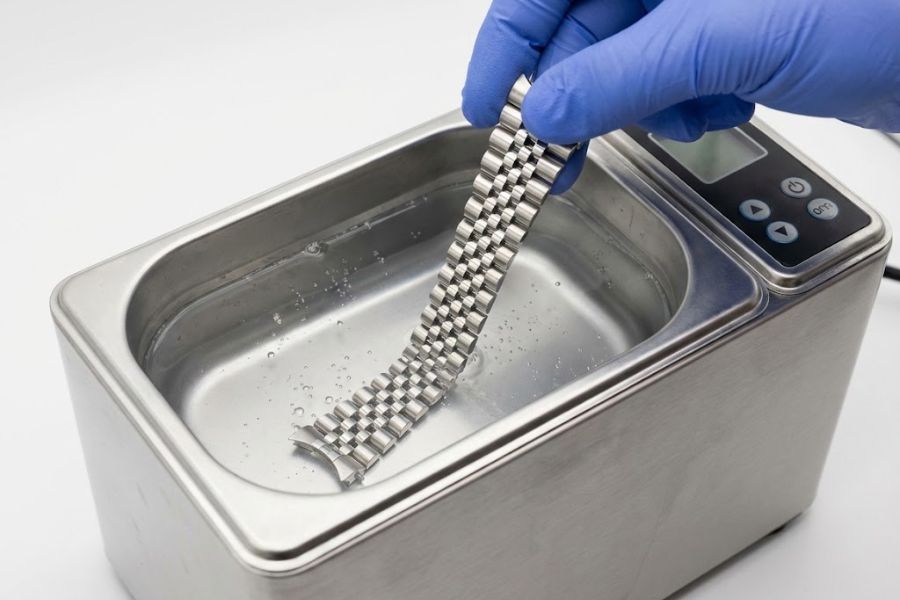
- Use an Ultrasonic Cleaner: Once a year, remove the metal band from the watch head and place it in an ultrasonic bath for a deep clean.
Preventative Maintenance Schedule
| Frequency | Maintenance Action | Benefit to the Watch |
|---|---|---|
| Daily | Wear the watch properly sized and snug. | Prevents the heavy watch head from hammering the internal pins. |
| Weekly | Scrub the metal with mild soap and a soft brush. | Removes the abrasive dirt and sweat paste before it hardens. |
| Yearly | Professional ultrasonic cleaning (band only). | Pushes out microscopic grit trapped deep inside the pinholes. |
Should I wear my watch tight or loose to stop damage?
You must wear your watch snugly. This is the biggest mistake owners make. Many people think wearing it loose puts less tension on the metal. The exact opposite is true. When a heavy watch is loose, gravity pulls it down. Every time you swing your arm while walking, that heavy steel case slams against the tiny pins inside the links. By wearing it snugly, the watch stays planted firmly against your skin, eliminating the hammering effect and saving your investment.
By understanding what to look for and how to maintain your piece, you can safely navigate the pre-owned market. Keep your bands clean, wear them snug, and always remember to ask for the droop test photo before you buy.