
Is your Rolex running slow? You expect a Superlative Chronometer to be perfect, yet you look down at your wrist and realize your relatively new watch is losing ten, fifteen, or even thirty seconds a day. You are not crazy, and you are not alone. You are likely experiencing the single most controversial technical issue in the modern watch world.
It is known as the “32xx Low Amplitude Issue,” and it is the primary reason owners of the newest Submariners, Datejusts, and GMT-Masters find their Rolex running slow after just a year or two of ownership. While many dealers stay silent about potential flaws to protect sales, Toronto Watch Exchange believes in transparency.
If this daily annoyance has you worried, this guide will explain exactly why it is happening, which 3235 models are affected, and how we can help you fix the issue.
Understanding Why a Modern Rolex Starts Running Slow Unexpectedly
To understand the problem, you first need to understand the engine inside your watch. Around 2015, Rolex began phasing out its legendary 3135 movement. The 3135 was a tank. It was used for thirty years and was virtually bulletproof. However, technology moves forward. Rolex wanted to increase the power reserve from 48 hours to 70 hours to compete with other luxury brands.
Enter the 3235 Calibre (and its siblings, the 3230 and 3285). This new family of movements features the “Chronergy Escapement,” which is a highly efficient system designed to consume less energy. On paper, it is a masterpiece. It offers a 70-hour power reserve and anti-magnetic properties. However, real-world usage has revealed a specific weakness that results in a Rolex running slow after just a year or two of ownership.
The issue is rarely a broken part. It is almost always a lubrication failure. When the oil inside specific points of the movement dries up, premature friction occurs. This friction drains the energy from the mainspring before it reaches the balance wheel. The result is a watch that struggles to keep up and eventually starts losing significant time.
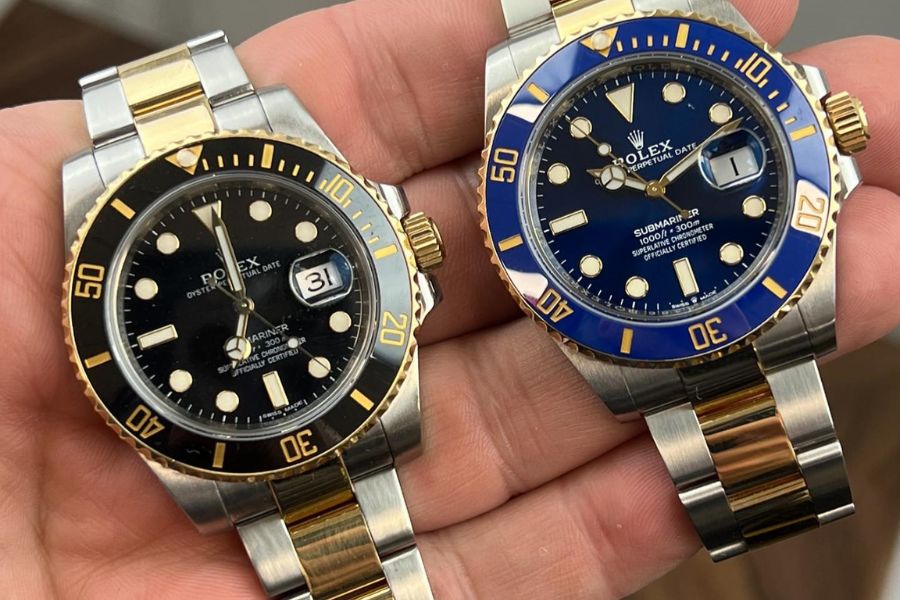
The Specific Models Prone to Rolex Running Slow Issues
This issue does not affect every Rolex. It is specific to the “32xx” generation of movements introduced roughly around 2015 and rolled out to other models over the next few years. If you own an older model from the early 2000s or 1990s, you are likely safe from this specific defect. If you are looking to buy a Rolex watch from the current catalog, you should check if it falls into these categories.
The table below outlines the most common references that use these movements:
| Model Name | Reference Numbers | Movement Calibre |
|---|---|---|
| Submariner Date (41mm) | 126610LN, 126610LV | 3235 |
| Submariner No-Date (41mm) | 124060 | 3230 |
| GMT-Master II | 126710BLRO, 126710BLNR | 3285 |
| Datejust 36 & 41 | 126234, 126300, 126334 | 3235 |
| Sea-Dweller (43mm) | 126600 | 3235 |
| Explorer (36mm & 40mm) | 124270, 224270 | 3230 |
If your watch reference starts with “12” (like the 126610 Submariner), it contains this new movement architecture. These are fantastic watches, but they are the ones we most frequently see when a customer complains about their Rolex running slow.
Identifying the Symptoms of a Rolex Running Slow Due to Movement Defects
How do you know if your watch is suffering from the “Low Amplitude” bug or if it just needs a standard service? Standard wear and tear happens over five to ten years. This specific issue presents itself much faster. You might notice these specific behaviors:
- Perfect Performance at First: The watch likely ran perfectly (+/- 0 seconds) for the first 12 to 18 months of ownership.
- Sudden Drop in Accuracy: Unlike normal wear, which causes a gradual drift, this issue hits hard. You might go from -1 second a day to -15 seconds a day within a few weeks.
- Loss of Power Reserve: Even though the watch is rated for 70 hours, you might find it dead on your nightstand after only 30 or 40 hours of rest.
- Positional Variance: The watch might keep decent time when lying flat on a table but loses massive amounts of time when worn on the wrist.
If you spot these signs on a watch that is less than five years old, you are almost certainly dealing with the 32xx lubrication fault. It is a frustrating realization, but identifying the problem is the first step toward fixing it.
The Technical Truth: What Causes the 3235 Movement to Fail?
We need to get technical for a moment. You don’t need to be a watchmaker to understand this, but it helps to know the “why” so you can speak confidently when you seek repairs. The core reason for a Rolex running slow in these instances comes down to “Amplitude.”
- Amplitude is the degree of rotation of the balance wheel.
- Think of it like a child on a swing.
- A healthy swing goes high up in the air (high amplitude).
- A tired swing barely moves back and forth (low amplitude).
- A healthy Rolex movement should have an amplitude between 270 and 310 degrees.
When we test these problematic watches on our timegraphers, we often see the amplitude drop below 200 degrees.
The Second Wheel Pivot and Lubrication Breakdown
The primary suspect in this mystery is the Second Wheel Pivot. In the 32xx movements, this specific gear bears a high load. Reports from watchmakers worldwide suggest that the lubrication on this pivot degrades or migrates away much faster than anticipated. Once the pivot is dry, it begins to grind.
This grinding creates friction. Friction eats up the energy from the mainspring. By the time that energy reaches the balance wheel, there isn’t enough power left to keep a strong “swing.” The balance wheel slows down, the tick-tock rhythm drags, and you end up with a Rolex running slow.

How Low Amplitude Leads to a Rolex Running Slow
When the amplitude drops, the watch becomes unstable. It is easily affected by gravity and shocks. If your amplitude is sitting at a healthy 280 degrees, moving your arm won’t disrupt the timekeeping. If your amplitude is a weak 190 degrees, simply turning your wrist can cause the movement to stumble. This is why many owners report that the watch keeps a different time on the dresser than it does on the wrist.
Analyzing the Chronergy Escapement Flaw
Rolex designed the Chronergy escapement to be lighter and more efficient. It uses a nickel-phosphorus alloy, which is resistant to magnetism. While the geometry is brilliant, the interaction between the escapement and the pallet fork stones requires precise lubrication. If that oil fails, the efficiency gains are lost immediately. It is a high-performance engine that is very sensitive to its oil levels. Unlike the older 3135, which could run dry and dirty for years without complaining, the 3235 demands perfect conditions to maintain its accuracy.
Community Feedback: What Owners Say About Their Rolex Running Slow
You are not alone in this experience. If you browse the major horology forums, you will find hundreds of pages of discussion on this exact topic. Search for “Rolex 3235 issues” on Rolex Forums and you will see dedicated tracking threads where owners log their data.
The consensus in the community is mixed but clear on one thing: the issue is real. Some owners are on their third warranty repair. Others have owned their watches for four years with zero issues. This inconsistency suggests that it might be related to specific batches of oil or specific production runs. However, the sheer volume of reports confirms that a Rolex running slow is not an isolated incident for the 12-series references.
It is important to filter through the noise. People rarely go online to post “My watch is working perfectly.” They only post when they are angry. While the issue is widespread enough to be a known defect, it does not mean every single Submariner will fail. It simply means you need to be aware of the possibility.
Rolex Running Slow Solutions: Warranty vs Independent Repair
So your watch is losing time. What can you do about it? You generally have two paths: sending it back to the brand or visiting a specialized independent watchmaker like Toronto Watch Exchange.
The table below compares your options when dealing with a Rolex running slow:
| Feature | Official Service Center (RSC) | Independent Watchmaker |
|---|---|---|
| Cost | Free (if under 5-year warranty) | Paid (unless covered by store warranty) |
| Turnaround Time | 8 to 12 Weeks | 2 to 4 Weeks |
| The Fix | Part Replacement & Standard Service | Targeted Repair & Relubrication |
| Communication | Limited (No direct access to watchmaker) | Direct (Talk to the expert) |
| Polishing | Often mandatory or pushed | Optional (Preserve your unpolished case) |
Does the 5-Year Warranty Cover a Rolex Running Slow?
Yes. If your watch is dated within the last five years and you have the green warranty card, Rolex will fix this issue for free. They are well aware of the defect. When you send it in, you don’t even need to explain the technical details. Just state that the watch is losing time and has a low power reserve.
The rumor among watchmakers is that Rolex has quietly updated the parts. When a watch goes in for this specific warranty work, they likely swap the affected bridge or pivot with a newer version that holds lubrication better. This is why we recommend using the warranty if you have it. If your warranty has expired, that is where we come in.
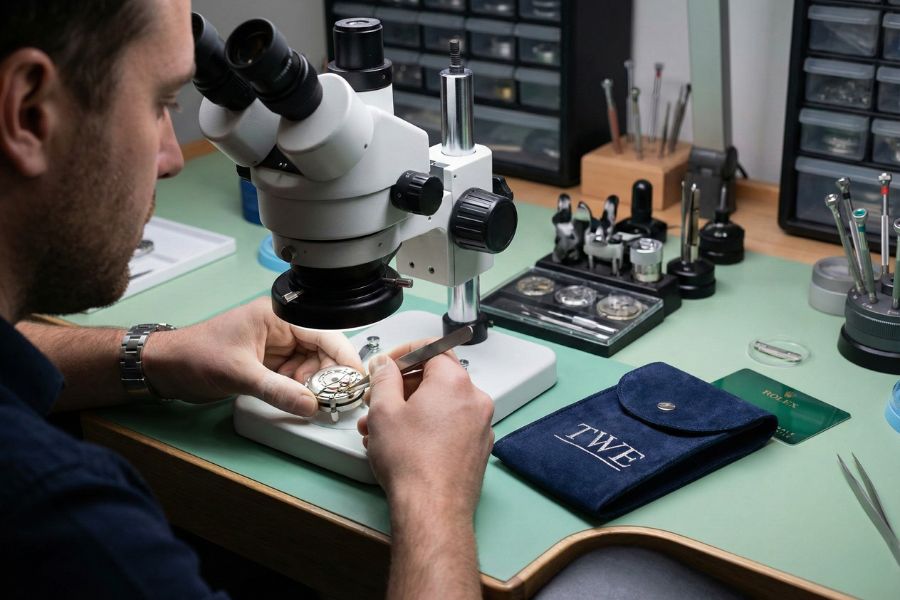
At Toronto Watch Exchange, we can service the 3235 movement. We use modern synthetic oils that are designed to resist migration. If your Rolex watch is out of warranty, we can strip the movement, clean the dried gummed-up oil from the pivots, and re-apply the correct lubricants to restore the amplitude to factory specs.
Should You Avoid Buying 32xx Rolex Series Watches?
With all this talk of defects and a Rolex running slow, you might be wondering if you should avoid modern Rolexes entirely. Should you stick to the older 5-digit references? Not necessarily.
The 3235 is still an incredible feat of engineering. The winding efficiency is superior. The power reserve is genuinely useful for people who rotate watches. The resistance to magnetism is a huge plus in our digital world. The “Low Amplitude” issue, while annoying, is not catastrophic. It does not destroy the watch. It is simply a maintenance hurdle.
Verdict on Reliability
We see thousands of watches pass through our showroom. The vast majority of modern Submariners and GMTs run perfectly. The “lemon” rate is higher than in previous generations, but it is still relatively low in the grand scheme of production. We continue to buy, sell, and trade these models daily with confidence. We just ensure we test them thoroughly before they reach your wrist.
For more insights on how these movements compare to older ones, you can read technically dense breakdowns on WatchUSeek, where enthusiasts dissect the gear trains in microscopic detail.
Visit Toronto Watch Exchange for a Diagnosis
Nothing is more frustrating than a luxury item that doesn’t work as promised. If you suspect your watch is suffering from the 3235 blues, do not let it sit in a drawer gathering dust.
Bring your watch to Toronto Watch Exchange. We can place your watch on our professional timegrapher in seconds. We will show you the numbers on the screen. You will see the amplitude for yourself. If it reads 280, your watch is fine and might just be magnetized. If it reads 190, we can discuss your options for warranty or repair.
Whether you want to trade it in for an older, reliable model or get it running like new again, we are here to help you solve the mystery of your Rolex running slow. Visit our shop today and let’s get your timekeeping back on track.